Strengths of Kontentino (and why it often beats ZoomSphere in day-to-day marketing reality)
1) Approval-first workflow that reduces review cycles (especially with clients)
Kontentino’s collaboration and approval model is designed to eliminate “approval chaos”:
- Live post previews to reduce surprises at publish time
- A deliberately simple approval decision: approve vs rework (this sounds basic, until you’re managing 20 stakeholders)
- In-context chat/comments and activity log so feedback and history stay attached to the post
- Mobile approvals so clients/managers can approve without opening a laptop
This “approval simplicity” is not just a product claim. Reviewers repeatedly cite client collaboration as a reason to choose Kontentino. For example, one Capterra review highlights full collaboration with clients and post-level chat.
Why this matters vs ZoomSphere: ZoomSphere can absolutely support approvals, but its approvals often live across two places (Scheduler + Workflow Manager), and ZoomSphere’s own guidance describes manually linking Scheduler posts and Workflow cards (copying/pasting links between them). That’s workable, but adds friction at scale.
2) Visual planning that’s built for marketers (not “project management people”)
Kontentino leans into planning how marketers actually think:
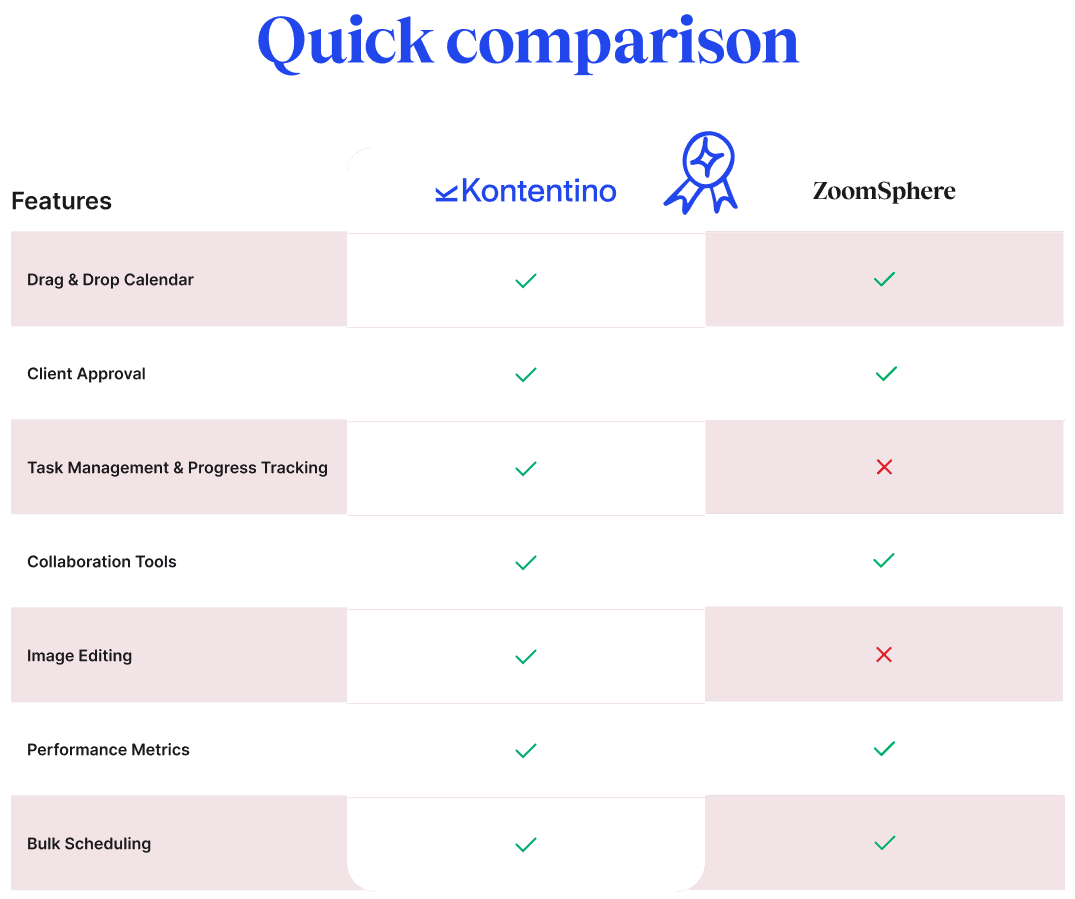
- Drag-and-drop calendar + alternate views
- Live previews across platforms to prevent creative mistakes and formatting surprises
- Bulk scheduling and time-savers for repetitive work
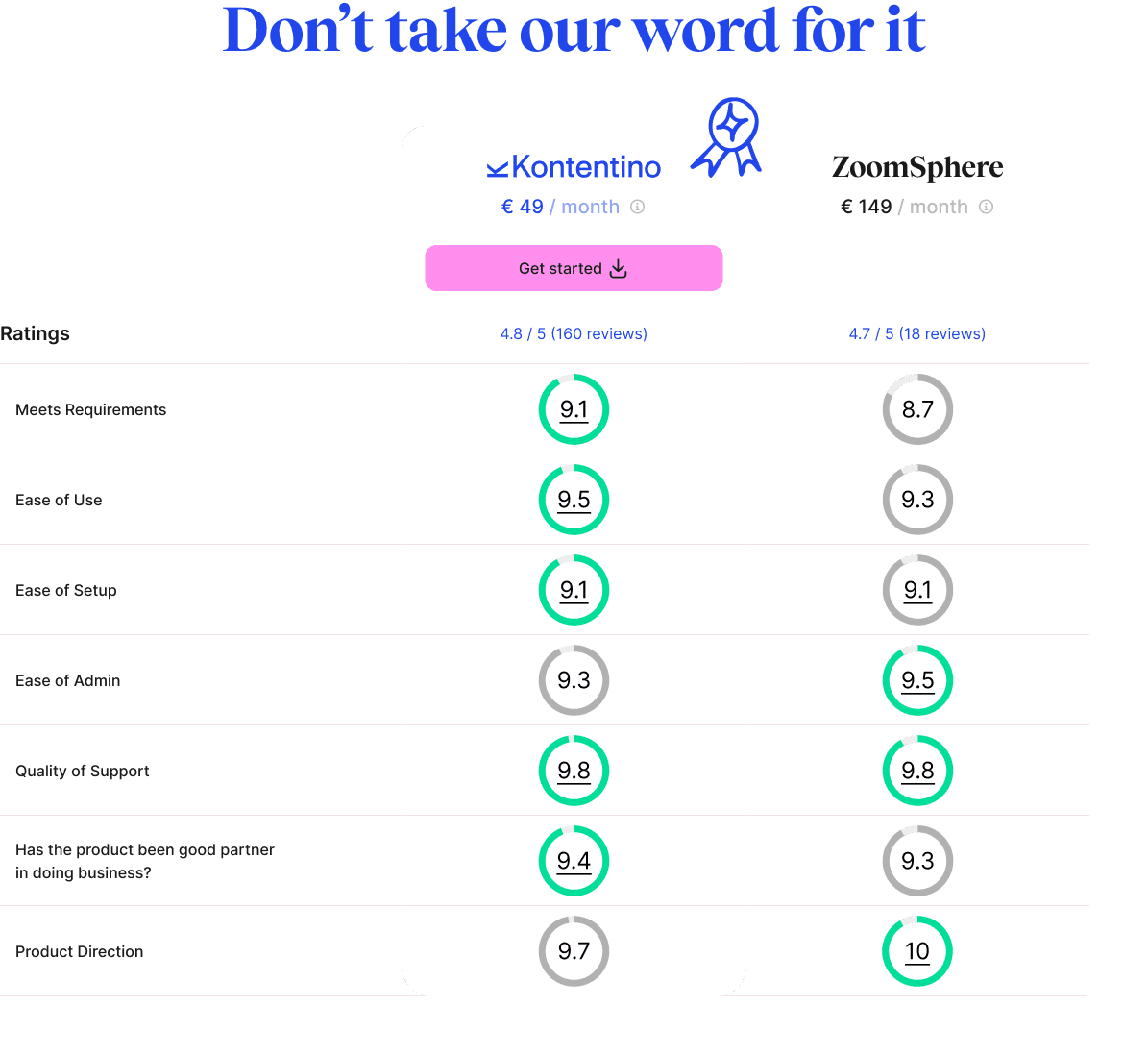
A practical takeaway: if your weekly workflow starts with “what’s going out next week across all brands?”, Kontentino’s calendar-first UX tends to feel immediately natural. (This is also reflected in “ease of use” scores and review volume on major platforms.)
3) Better value for realistic team sizes (where most buyers actually are)
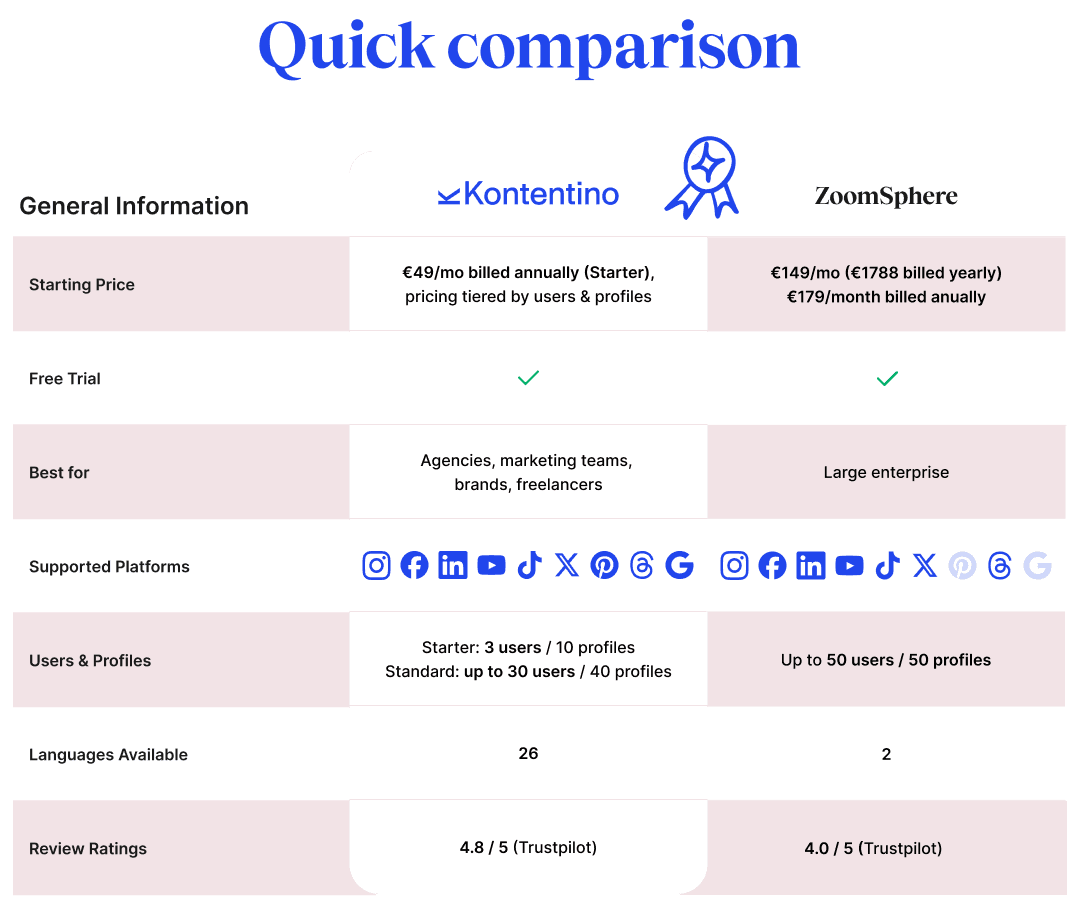
ZoomSphere’s base subscription is priced for teams that can use up to 50 users and 50 social channels.
That can be great if you truly need that capacity.
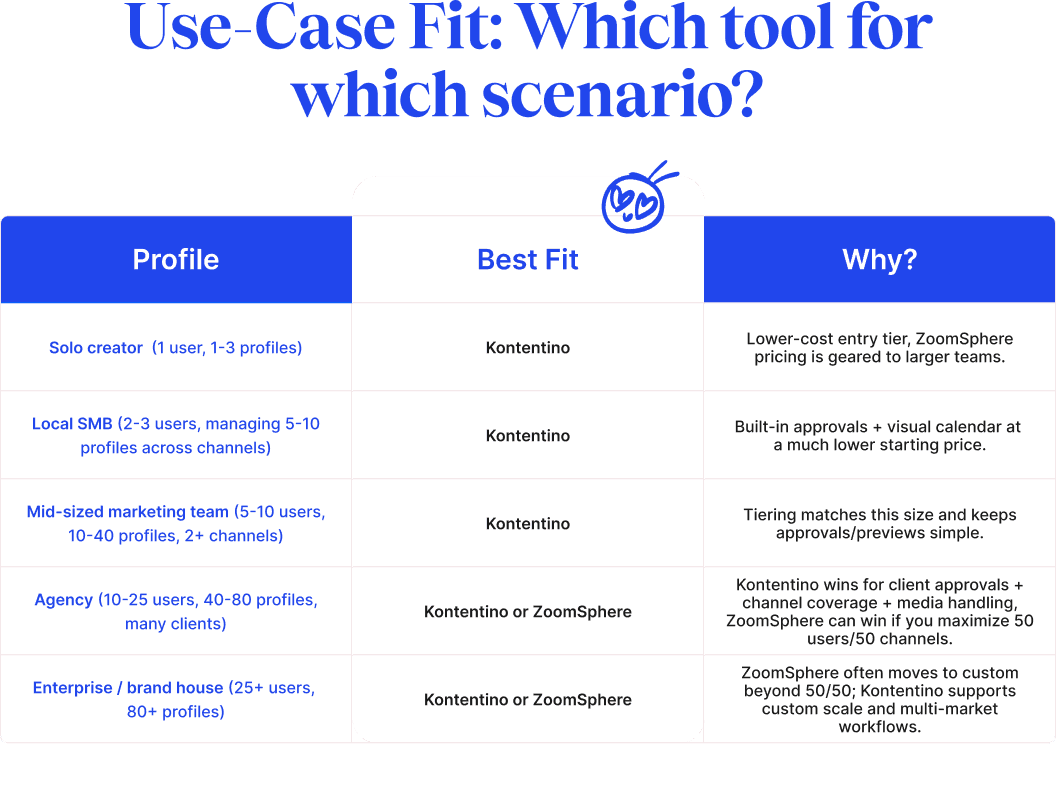
But most marketing teams and many agencies evaluating tools in 2025–2026 are closer to 3-10 users with 10-40 profiles / pages.
Kontentino’s pricing is tiered precisely for that reality, starting at €49/month billed annually for 3 users/10 profiles, and scaling in clear steps (5/10/15/20 users).
This reduces the most common “tool regret” problem: overbuying capacity you won’t use.
4) Channel coverage that’s especially relevant in Europe: Pinterest + Google Business Profile
Kontentino publicly lists support for channels including Google Business Profile and Pinterest, alongside Facebook/Instagram/LinkedIn/TikTok/X/Threads/YouTube.
ZoomSphere’s public ecosystem is strong for the major networks, and it now clearly documents Threads scheduling features (e.g., polls and video posts) in its Help Center.
However, Pinterest and Google Business integration are currently not available.
If you manage multi-location brands, Pinterest-led retail funnels, or EU local marketing, this difference can be decisive.
5) Unlimited media storage (a quiet advantage that saves real operational time)
Kontentino positions its media library as unlimited storage for assets.
ZoomSphere includes Files with 20GB in the subscription (and emphasizes Files as a shared cloud storage system).
If you handle lots of video, product photography, or evergreen creative variants, unlimited storage can meaningfully reduce file housekeeping and “where did we put that?” friction.
6) Strong “buyer confidence” signals (review volume + ratings)
In martech procurement, review depth matters because it reduces risk. As of Feb 2026:
- Kontentino: 4.8/5 on G2 (160 reviews) and 4.7 on Capterra (197 reviews)
- ZoomSphere: 4.7/5 on G2 (18 reviews) and 4.7 on Capterra (22 reviews)
Both tools are rated well, but Kontentino has substantially more publicly visible feedback, which many buyers interpret as lower adoption risk.
7) Europe-friendly company context (EU-based entity + payments)
Kontentino’s Privacy Policy identifies the company as Kontentino s.r.o., Bratislava, Slovakia.
Its Slovak pricing FAQ also states payment options including PayPal and SEPA bank transfer (annual billing).
ZoomSphere is also Europe-based (Prague, Czech Republic) and documents EU VAT handling, but does not accept PayPal or bank transfers (card only, per pricing FAQ).
For some European procurement teams, SEPA + invoice workflows are not a “nice-to-have” they are a requirement.
Strengths of ZoomSphere (where it’s genuinely strong and when it can beat Kontentino)
ZoomSphere is not a lightweight tool. It’s built for teams that want a scheduler plus a compact “work hub.”
1) Workflow Manager is a real Kanban-style planning system (beyond a content calendar)
ZoomSphere’s Workflow Manager is explicitly positioned as a visual board with columns/cards, checklists, deadlines, and assignments, and it supports inviting clients with controlled access.
If your process looks like:
- ideation → drafting → internal review → client review → scheduling → publishing
…and you want that tracked like a mini project plan, ZoomSphere’s Kanban model is a strong match.
2) Included “work hub” features: Notes + Chat + Files (20GB) + Drive/Dropbox integrations
ZoomSphere’s subscription includes: Scheduler, Workflow Manager, Notes, Chat, Files (20GB) It also offers Google Drive and Dropbox integrations for pulling files into ZoomSphere apps.
3) Big included caps can be cost-effective for large teams
ZoomSphere’s base plan supports up to 50 users and 50 connected social channels. If you’re a large agency team that truly uses that scale, ZoomSphere can be cost-efficient on a per-seat basis.
4) Strong documentation for formats (and some ad-adjacent functionality)
ZoomSphere’s supported formats documentation includes items like dark posts under Facebook formats. If your team needs certain platform-specific post types and validation rules, ZoomSphere’s “formats-first” approach may be compelling.