
Your Instagram engagement rate is the percentage of people who interact with your content relative to your audience size or reach. It’s the single most useful metric for understanding whether your content is actually resonating – more reliable than follower count alone, and the number brands, agencies, and platforms look at when evaluating account quality.
In this guide you’ll find every engagement rate formula you need for both Instagram and TikTok, what counts as good engagement in 2026, how to see your likes and interactions on Instagram, and how to use your engagement data to grow your account – and eventually monetize it.
TL;DR: The most common Instagram engagement rate formula is (total likes + total comments) / total followers x 100. A rate of 1%-3% is considered good for most accounts. For TikTok, divide total interactions by total followers and multiply by 100 – with average rates significantly higher than Instagram.
Quick Reference: Engagement Rate Benchmarks by Platform (2026)
| Platform | Low | Average | Good | Excellent |
|---|---|---|---|---|
| Instagram (under 10K followers) | Under 1% | 1%-3% | 3%-6% | 6%+ |
| Instagram (10K-100K followers) | Under 0.5% | 0.5%-2% | 2%-4% | 4%+ |
| Instagram (100K+ followers) | Under 0.3% | 0.3%-1% | 1%-2.5% | 2.5%+ |
| TikTok (all account sizes) | Under 3% | 3%-9% | 9%-15% | 15%+ |
TikTok engagement rates are naturally higher than Instagram’s because TikTok’s For You page algorithm surfaces content to non-followers at a much higher rate, which generates more interactions per post relative to follower count.
Why Instagram Engagement Rate Matters More Than Follower Count
Follower count tells you how many people could see your content. Engagement rate tells you how many actually care.
For many people starting on Instagram, follower count feels like the golden metric. More followers, more eyeballs, more leads. In practice, it doesn’t work that way. Followers who don’t engage with your content don’t convert into customers, don’t signal quality to the algorithm, and don’t help your account grow.
Instagram’s algorithm uses engagement signals – likes, comments, saves, shares – as its primary quality indicator. Posts that generate strong early engagement get pushed to more people. Posts that don’t get buried. This means a smaller account with a 5% engagement rate will often outperform a larger account with 0.5%.
Engagement rate also matters because it’s what brands and agencies look at when evaluating partnerships, sponsorships, and influencer collaborations. A creator with 20,000 followers and a 6% engagement rate is more attractive to most brands than one with 200,000 followers and a 0.4% rate.
The Fake Followers Problem and Why It Destroys Engagement Rate
Buying fake followers is the fastest way to tank your engagement rate – and the damage is permanent until those followers are purged.
Here’s the math: if you have 10,000 followers and 500 of them engage per post, your engagement rate is 5%. If you buy 10,000 fake followers, you now have 20,000 followers but still only 500 real engagements – your rate drops to 2.5% overnight. Fake followers don’t comment, don’t save, and don’t buy anything. They just inflate the denominator of your engagement formula while contributing nothing to the numerator.
Instagram’s community guidelines make it clear that fake followers are periodically purged. Beyond the algorithmic damage, fake followers are immediately recognizable to anyone who looks at your account – low engagement relative to follower count is an obvious red flag.
If you’re investing in Instagram marketing, you need to know how that investment is paying off. And while data like followers, likes, comments, and impressions are good indicators of page health, arguably the most important metric you should be tracking is engagement.
So how do you calculate Instagram engagement rate? Well there’s no real cut and dry answer simply due to the vast array of possible interactions your audience can have with your page. Link clicks, saves, DMs, all of these count as engagement. So you can see how calculating “true” engagement can get tricky.
That’s why today we’ll guide you through different methods for calculating Instagram engagement, what actions count as engagement and why engagement is so important in the first place.
Let’s dive in.
Why is Instagram engagement so important?
For many people starting out on Instagram, follower count is the golden metric. The more followers, the more people see your brand, the more leads you can push into your funnel. Right? Well actually no. If the followers you have aren’t interested in converting, those followers are useless.
And it’s easy to fall into that rut. Many brands fail to realize that Instagram should be used as a business tool. You’re a business owner, not an influencer. The content you share should be relevant to a very specific group of people, a group that you can actually convert into paying customers.
And the best way to gauge the effectiveness of your Instagram content strategy is by analyzing how many people are engaging with that content and in what way they are engaging. If you craft a piece of content that you want to be saveable and evergreen, measure the amount of saves, not just the amount of likes.
If you’re looking to increase the amount of comments, that’s a metric you should focus on.
We’ll go more into depth about how to calculate Instagram engagement rate in a minute.
But first, let’s talk about fake followers.
The fake followers discussion
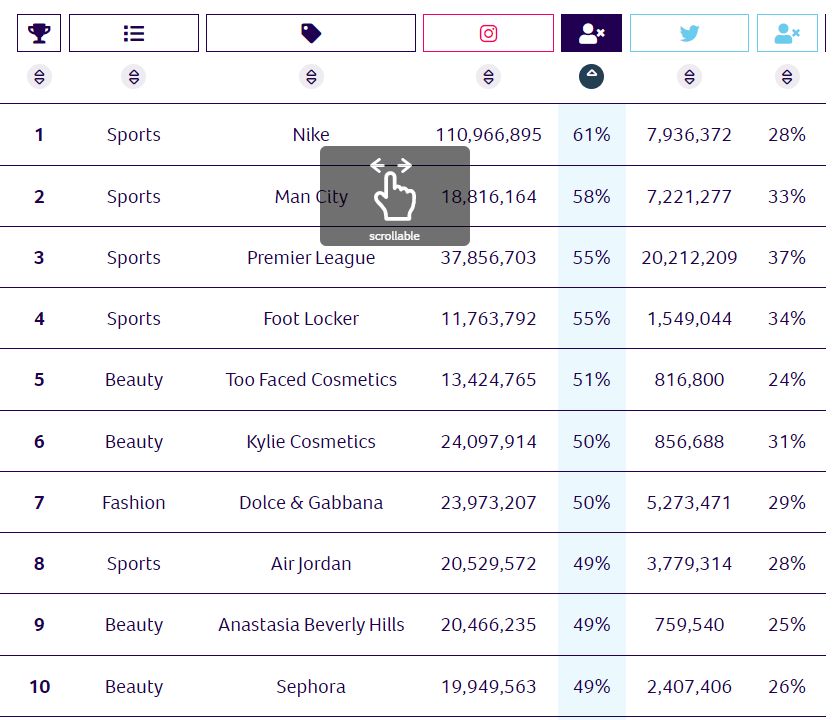
Some of the biggest brands in the world make the same mistake of glamorizing their social media presence by buying fake followers.
Pilotfish has compiled a list of global companies that have purchased fake followers.
What Counts as Engagement on Instagram?
Before calculating anything, it helps to understand what actions actually qualify as engagement. Not every formula includes every metric – which one you use depends on your goals.
Standard engagement metrics:
- Likes
- Comments
- Saves
- Shares
- Story replies
- Story sticker taps (polls, questions, sliders)
- DMs triggered by a post
- Link clicks (in bio or Stories)
- Branded hashtag usage
- Mentions and tags
For most reporting purposes, the “core” engagement metrics are likes, comments, saves, and shares. Saves are particularly valuable – a save signals strong content quality and boosts algorithmic distribution more than a like does.
How to See Your Likes on Instagram
To see your likes on Instagram, go to your profile, tap a post, and the like count appears directly under the image.For a full breakdown of post-level interactions, go to Insights:
- Tap a post on your profile
- Tap “View Insights” below the image
- You’ll see likes, comments, saves, shares, reach, and impressions broken down per post
For account-level data, go to your professional dashboard: tap the menu icon (top right of your profile), then tap “Insights.” From there, tap “Content you’ve shared” and filter by date range and metric to see which posts drove the most engagement.
Note: Instagram removed the ability to see others’ likes on their posts in 2019 for most regions. You can only see your own post’s like counts – not other accounts’.
Instagram Engagement Rate Formulas
There’s no single “correct” formula for Instagram engagement rate. The right one depends on what you’re trying to measure. Here are the four most widely used.
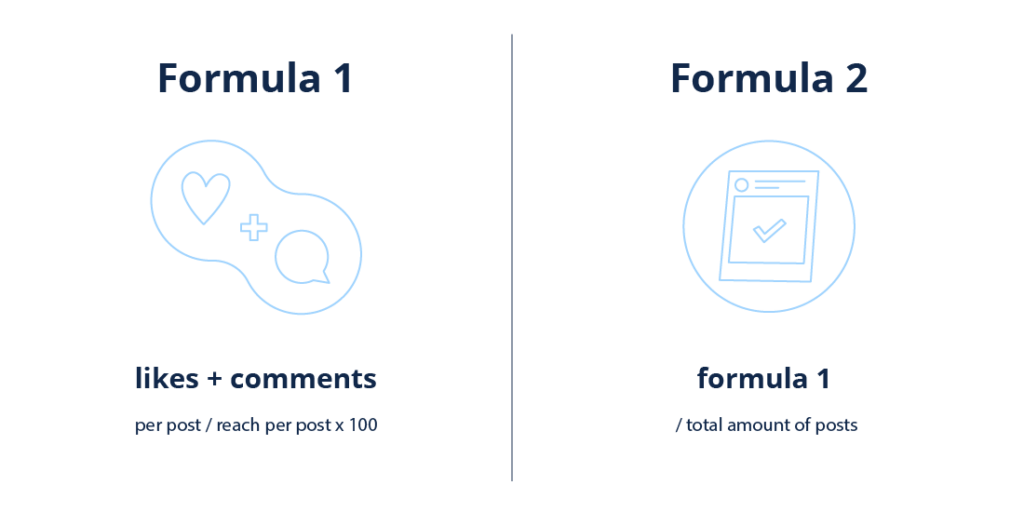
Formula 1: Engagement Rate by Reach (Best for content performance)
This formula measures how well your content performed relative to the number of people who actually saw it. It’s the most accurate reflection of content quality because not all of your followers see every post.
For a single post: Engagement rate = (likes + comments) / reach x 100
For your account average: Average engagement rate = sum of per-post rates / total number of posts
When to use it: When evaluating the performance of individual posts, comparing content types (Reels vs. carousels vs. static images), or reporting on campaign performance.
Limitation: Reach can fluctuate based on factors outside your control (posting time, algorithm changes, whether content got surfaced to non-followers), making it harder to benchmark consistently over time.
Formula 2: Engagement Rate by Followers (Most common, best for benchmarking)
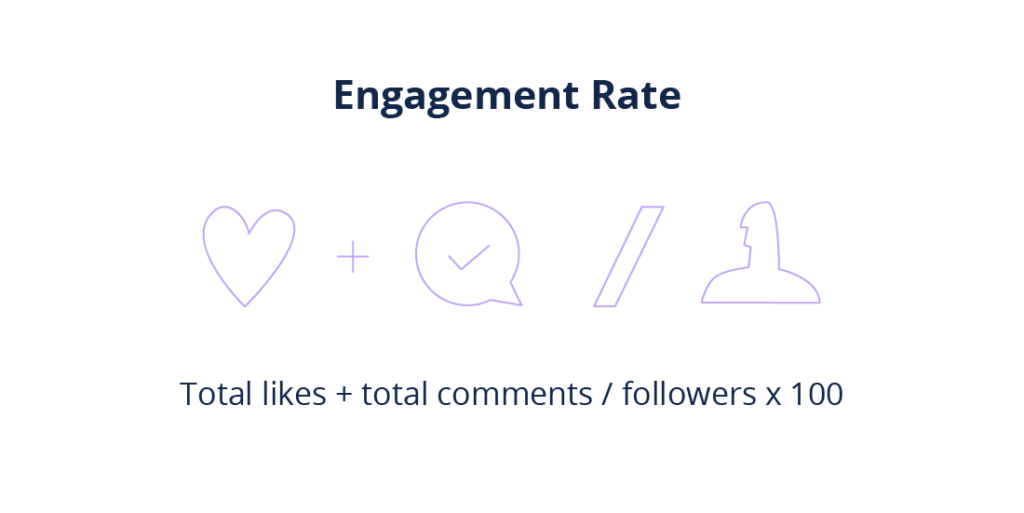
This is the most widely used formula and the industry standard for comparing accounts. Because it uses follower count – a stable number – it’s easy to track over time and compare against other accounts.
Engagement rate = (total likes + total comments) / total followers x 100
When to use it: For month-over-month tracking, Instagram followers growth reporting, influencer vetting, and competitive benchmarking.
Limitation: Not all of your followers see your posts – the percentage who do is your reach rate. A shrinking reach rate (showing your content to fewer followers over time) will inflate your follower-based engagement rate even if content quality is declining. Always monitor reach rate alongside this formula.
Formula 3: Engagement Rate by Impressions
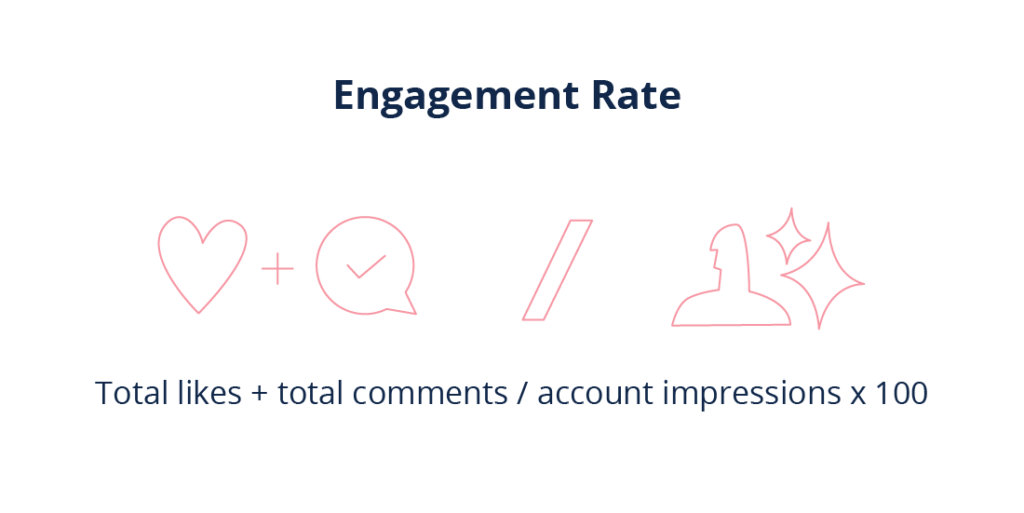
This formula divides engagement by impressions – the total number of times your content was displayed on a screen, including multiple views by the same person.
Engagement rate = (total likes + total comments) / account impressions x 100
When to use it: For paid content and ads reporting. Impressions are the standard metric for ad delivery, making this formula most relevant when measuring paid campaign efficiency or tracking ad fatigue.
Key distinction: Impressions count every view (including repeat views by the same person). Reach counts unique viewers only. For organic content, reach is the more meaningful denominator.
Formula 4: Total Engagement Rate (Most comprehensive)
This formula captures the full picture of how people interact with your content by including saves and shares alongside likes and comments.
Engagement rate = (total likes + total comments + total saves + total shares) / account impressions x 100
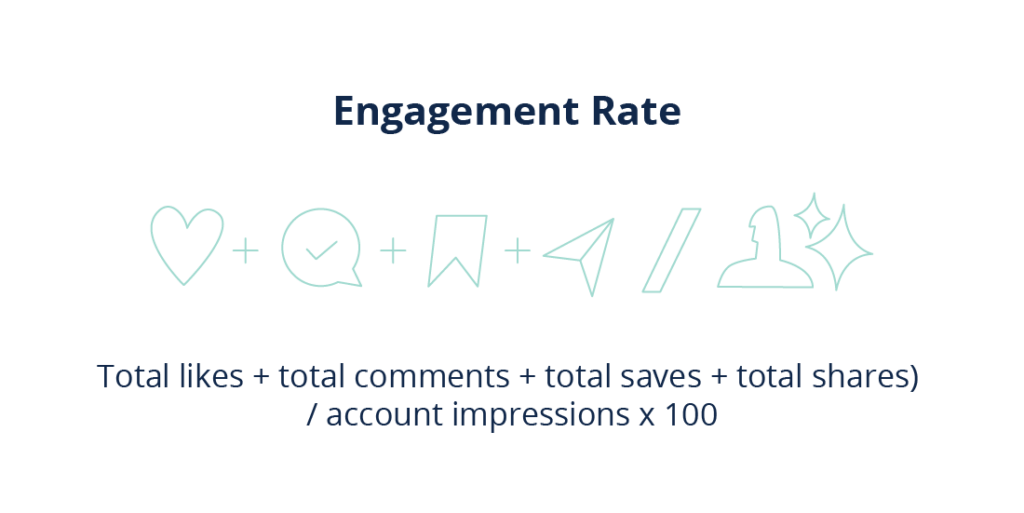
When to use it: For holistic performance reviews, quarterly reports, and when you want to understand content quality beyond surface-level interactions. Saves and shares are strong quality signals – content that people save is content they found genuinely useful, and content people share is content they want others to see.
What Is a Good Engagement Rate on Instagram in 2026?
A good engagement rate on Instagram depends on your account size. Larger accounts naturally have lower engagement rates because not all followers stay equally active over time.
According to Social Insider’s 2025 Instagram benchmarks, average Instagram engagement rates by account size are:
- Under 10K followers: 3%-6% is a healthy range; 6%+ is excellent
- 10K-100K followers: 1%-3% is average; 3%+ is strong
- 100K-1M followers: 0.5%-1.5% is typical for this tier
- 1M+ followers: Under 1% is common; even 0.5% represents millions of interactions
Content type also significantly affects benchmarks. Carousels consistently outperform static images on engagement rate across all account sizes. Reels generate higher reach but often lower engagement rate than carousels, because Reels reach many non-followers who are less likely to engage deeply.
How to Calculate TikTok Engagement Rate
The TikTok engagement rate formula is the same structure as Instagram’s by-followers formula, but TikTok benchmarks are significantly higher. Because TikTok’s For You page surfaces content primarily to non-followers, interaction rates per post are naturally inflated compared to platforms where content is mainly shown to existing followers.
TikTok Engagement Rate Formula
Calculate TikTok engagement rate = (total likes + total comments + total shares) / total followers x 100
For a single video: TikTok video engagement rate = (likes + comments + shares on that video) / total followers x 100
What Is My TikTok Engagement Rate? (How to find it)
To find your TikTok engagement rate, go to your Creator Tools > Analytics. Here’s what to look for:
- Go to your profile and tap the menu (top right)
- Tap “Creator Tools,” then tap “Analytics”
- Under “Content,” tap any video to see its likes, comments, shares, and views
- Use the formula above: add likes + comments + shares, divide by your total followers, multiply by 100
TikTok’s native analytics don’t calculate engagement rate directly – you have to do the math yourself per video, or use Kontentino’s analytics dashboard to pull this automatically across all your TikTok content.
What Are Good TikTok Engagement Rates in 2026?
Average TikTok engagement rates are considerably higher than Instagram’s because of how the platform’s algorithm distributes content.
- Under 5,000 followers: 8%-15% is typical; 15%+ is excellent
- 5K-50K followers: 5%-10% is the average range
- 50K-500K followers: 3%-8% is common
- 500K+ followers: 1%-5%, with rates declining as follower count grows
These are general benchmarks. TikTok engagement rates vary significantly by niche – entertainment and comedy accounts typically outperform educational or brand accounts on raw engagement rate.
TikTok Engagement Rate by Video vs. by Account
You can calculate TikTok engagement rate at two levels:
Per video: (likes + comments + shares on that video) / total followers x 100 – useful for identifying which content formats resonate most
Account average: Sum of all video engagement rates / total number of videos – useful for reporting and benchmarking against niche averages
For agencies managing multiple TikTok accounts, doing this manually for every video is time-consuming. Kontentino’s analytics tools track engagement rate automatically across all your managed accounts and let you export reports for clients.
How to Improve Your Instagram Engagement Rate
Knowing your number is useful. Improving it is the point. Here are the levers that consistently move Instagram engagement rate in the right direction:
Post carousels over static images wherever possible Carousels get re-served to users who didn’t swipe through on first view, generating a second chance at engagement. They also tend to drive more saves, which is one of the highest-value engagement signals.
Optimize for saves, not just likes Saves are Instagram’s strongest quality signal. Create content that people want to refer back to – tutorials, checklists, step-by-step guides, templates, and data-rich posts. Ask yourself: “Would someone save this?” before posting.
Post when your audience is most active Engagement in the first 60 minutes is a major ranking signal for Instagram’s algorithm. Publishing during your audience’s peak activity window maximizes early interactions. See our guide on the best times to post on Instagram for platform benchmarks and how to find your account-specific windows.
Use a consistent posting schedule Irregular posting patterns confuse the algorithm and train your audience to stop checking for your content. A steady cadence – even 3 times a week – outperforms a burst of 10 posts followed by two weeks of silence. Kontentino’s content calendar helps you plan and maintain that consistency without scrambling every day.
Write captions that invite responses A caption that ends with a specific, easy-to-answer question consistently drives more comments than a caption that doesn’t. “Which of these would you try first?” outperforms “Let us know your thoughts!” every time.
Keep engagement qualitative, not just quantitative High comment counts mean nothing if the comments are bots or generic spam. Regularly review your comments – are real people engaging? What are they saying? Qualitative signals from your audience are often more useful for strategy than raw numbers.
How to Monetize Instagram Using Engagement Rate
Understanding your engagement rate is a prerequisite for monetizing Instagram, because most monetization paths depend directly on it.
Brand partnerships and sponsorships – brands evaluate creators primarily on engagement rate, not follower count. A creator with 15,000 followers and a 7% engagement rate is more likely to land a paid collaboration than one with 100,000 followers and 0.8%. When pitching to brands, lead with your engagement rate, not your follower number.
Instagram’s Creator Marketplace – Instagram’s built-in branded content marketplace uses engagement rate as a key eligibility and visibility signal. Maintaining a healthy rate makes your profile more discoverable to brands actively searching for partners.
Affiliate marketing – the conversion rate on affiliate links correlates directly with how much your audience trusts and engages with your content. High engagement = higher trust = higher conversion.
Digital products and services – engagement rate predicts how well your audience will respond to a product launch or service offer. An engaged audience of 5,000 will buy from you at a higher rate than a disengaged audience of 50,000.
For a full breakdown of revenue strategies, see our guide on how to monetize Instagram.
How to Track Engagement Rate Across Multiple Accounts
If you’re managing Instagram and TikTok for multiple clients or brand profiles, manually calculating engagement rates for every account every month is not sustainable.
Kontentino’s analytics and reporting tools automatically calculate engagement rate across all your connected accounts – Instagram, TikTok, Facebook, LinkedIn, and more – and surface the data in a single dashboard. You can:
- Track Instagram followers growth and engagement trends over custom date ranges
- Compare performance across multiple accounts or profiles side by side
- Export custom reports for clients in a few clicks
- Set up scheduled reports so you’re never building decks from scratch
Start a 14-day free trial – no credit card required.
Frequently Asked Questions About Engagement Rate
What is Instagram engagement rate?
Instagram engagement rate is the percentage of your audience (or reach) that actively interacts with your content through likes, comments, saves, and shares. It’s used to measure how well your content resonates with your audience and is a key indicator of account health, content quality, and monetization potential.
What is a good Instagram engagement rate in 2026?
For accounts under 10K followers, 3%-6% is a healthy engagement rate. For accounts between 10K and 100K followers, 1%-3% is average and 3%+ is strong. Larger accounts (100K+) typically see lower rates (0.5%-1.5%) because not all followers remain equally active over time.
How do I calculate my engagement rate on Instagram?
The most common formula is: (total likes + total comments) / total followers x 100. For a more accurate reflection of content performance, use reach instead of followers: (total likes + total comments) / reach x 100. For a comprehensive view, include saves and shares in the numerator.
What is my TikTok engagement rate?
To calculate your TikTok engagement rate, use: (total likes + total comments + total shares) / total followers x 100. Check your individual video stats in TikTok Creator Tools > Analytics > Content, tap a video, and use those numbers in the formula. Average TikTok engagement rates range from 3% to 9% depending on account size.
How do I calculate TikTok engagement rate per video?
Tap any video in your TikTok analytics, note the likes, comments, and shares for that specific video, then divide the sum by your total follower count and multiply by 100. This tells you how well a specific video performed relative to your audience size.
What are good TikTok engagement rates?
For smaller TikTok accounts (under 5K followers), 8%-15% is typical. For mid-size accounts (5K-50K), 5%-10% is average. For larger accounts (50K-500K), 3%-8% is the norm. TikTok rates are naturally higher than Instagram’s because content is primarily distributed to non-followers via the For You page.
How do I see my likes on Instagram?
To see likes on a specific post, tap the post on your profile – the like count is displayed below the image. For detailed per-post engagement data, tap “View Insights” under any post on a professional account. For account-level engagement data, go to your professional dashboard via the profile menu and tap “Insights.”
Does follower count affect engagement rate?
Yes. Larger accounts almost always have lower engagement rates because the proportion of followers who actively engage decreases as follower count grows. This is why benchmarks are segmented by follower tier – comparing a 500K account’s engagement rate to a 5K account’s is not meaningful.
How does Instagram engagement rate connect to monetization?
Brands and agencies evaluate engagement rate – not follower count – as the primary signal when selecting partners for paid collaborations. A higher engagement rate means a more responsive, trusting audience, which translates to better conversion rates on affiliate links, product launches, and branded content. Understanding and improving your engagement rate is the first step to monetizing your Instagram presence.
Should I include saves in my engagement rate calculation?
Yes, where possible. Saves are one of Instagram’s strongest engagement signals and indicate that someone found your content genuinely valuable. Including saves in your formula gives a more accurate picture of content quality – especially for educational, tutorial, or reference content that people return to.