


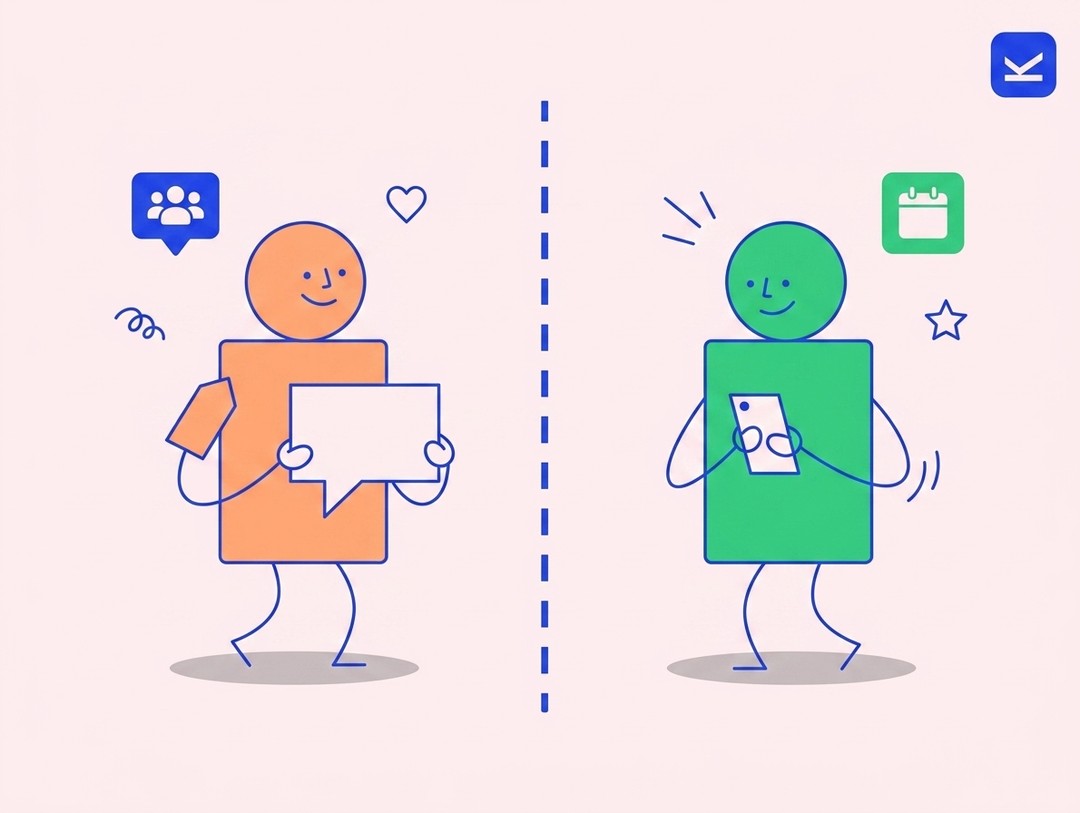
You’re scrolling through job listings, and you see two positions that sound almost identical – community manager and social media manager. Same company, different roles, but wait… aren’t they the same thing?
Spoiler alert: They’re not. And mixing them up could mean hiring the wrong person for the job (or applying for a role that’ll make you miserable). Let’s untangle this web once and for all.
What is a community manager?
A community manager is basically the heartbeat of your brand’s audience. Think of them as the person who builds a campfire and invites everyone to gather around, share stories, and actually connect with each other – just with the brand.
What is a community manager in practice? They’re the ones fostering relationships, sparking conversations, and making sure your audience doesn’t just follow you – they care about you. Community management is about creating a space where people feel heard, valued, and part of something bigger.
Here’s what that looks like day-to-day:
- Responding to comments and DMs (and we’re talking real conversations, not copy-paste responses)
- Moderating forums, Facebook groups, or Discord channels
- Organizing events, AMAs, or online meetups
- Turning customers into advocates who’ll defend your brand in the comments
- Gathering feedback and passing it to product or marketing teams
- Handling crisis situations with empathy and speed
Community managers are in it for the long game. They’re building trust, loyalty, and a sense of belonging that keeps people coming back – even when your competitor launches a flashy campaign.
And who is a social media manager?
Social media managers are the strategists, the content creators, the campaign launchers. If the community manager is hosting the party, the social media manager is designing the invitations, setting the playlist, and making sure the event trends.
They focus on:
- Planning and scheduling content across platforms
- Creating graphics, videos, and copy that stop the scroll
- Running paid ad campaigns and analyzing ROI
- Tracking metrics like reach, engagement, and conversions
- Staying on top of algorithm changes and platform updates
- Aligning social strategy with broader marketing goals
Social media managers are laser-focused on growth – followers, clicks, sales. They’re the ones experimenting with new formats, jumping on trends, and making sure your brand stays relevant in the feed. Need help streamlining this process? Check out our guide on how to create a social media content calendar that actually works.
The human touch of community management
Here’s the thing about community management: it’s deeply human work. You can’t automate empathy. You can’t schedule authenticity. Community managers spend their days:
- Reading between the lines of comments
- Recognizing regulars and making them feel special
- Diffusing tense situations before they explode
- Celebrating member wins (yes, even the small ones)
- Creating inside jokes and shared experiences
The goal? Transform passive followers into active participants. It’s not about broadcasting – it’s about facilitating conversations where the brand sometimes takes a backseat and lets the community shine.
A week in life of community manager
Monday: Coffee in hand, the community manager scans overnight comments. Someone’s frustrated about a delayed order. Time to jump in with empathy, solutions, and a direct line to customer support. Crisis averted, customer happy, comment section saved.
Tuesday: Hosting a live Q&A with the founder. Prepping questions from the community, moderating the session, making sure trolls don’t hijack the conversation. Post-event, they’re in the comments thanking everyone who participated and keeping the conversation going.
Wednesday: A loyal community member just hit a personal milestone. The community manager shoots them a congratulatory message and features their story. Small gesture, huge impact.
Thursday: Analyzing feedback patterns. Three people mentioned wanting a feature. Time to compile insights and present them to the product team. The community’s voice just shaped the roadmap.
Friday: Someone posted something negative. Instead of deleting it, the community manager responds publicly, acknowledges the issue, and follows up privately. Transparency wins again.
A week in life of social media manager
Monday: Reviewing weekend analytics. That meme posted Saturday? It flopped. But the behind-the-scenes reel crushed it. Mental note: more authenticity, fewer forced jokes. Time to adjust the content calendar (speaking of which, if your calendar is a hot mess, we’ve got content planning strategies that’ll save your sanity).
Tuesday: Content creation day. Photoshoot for next week’s grid, writing captions, designing carousel posts. Every piece needs to align with the campaign theme. Oh, and TikTok wants vertical video, Instagram wants Reels, LinkedIn wants thought leadership. Different content, different vibes, all due tomorrow.
Wednesday: Ad campaign launch. Setting up audience targeting, writing ad copy, A/B testing creative. The budget’s tight, so every click counts. Monitoring performance obsessively because stakeholders want results, like, yesterday.
Thursday: Trend alert! A sound is blowing up on TikTok. Can we make it work for the brand? Quick brainstorm, shoot a video, edit, post. Strike while the trend’s hot.
Friday: Monthly report time. Compiling metrics, creating charts, explaining why reach dropped (algorithm update) and how engagement increased (better content). Presenting strategy for next month. Rinse, repeat.
The toolbox: What each role actually needs
Community manager essentials:
- Community platforms: Discord, Slack, Facebook Groups, Reddit
- Moderation tools: For keeping spaces safe and spam-free
- CRM systems: To track member interactions and history
- Listening tools: Sprout Social, Brandwatch for monitoring mentions
- Empathy: Okay, not a tool, but seriously the most important one
Social media manager essentials:
- Scheduling platforms: Kontentino, Buffer, Hootsuite (shameless plug: Kontentino makes content approval a breeze)
- Design tools: Canva, Adobe Creative Suite
- Analytics platforms: Native insights, Google Analytics, social analytics tools
- Ad managers: Facebook Ads Manager, LinkedIn Campaign Manager
- Trend tracking: TikTok Creative Center, Twitter Trends, Google Trends
The pros and cons of both roles
Community manager:
Thumbs up
👍Deep connections: You’re building real relationships, not just chasing vanity metrics
👍 Direct impact: Your work creates loyal advocates who’ll defend your brand in the wild
👍 Meaningful work: Every day, you’re helping people, solving problems, making someone’s day better
👍 Variety: No two days look the same; you’re constantly adapting to your community’s needs
Thumbs down
👎 Emotionally draining: Dealing with negativity, complaints, and trolls takes a toll
👎 Always on: Communities don’t sleep, and neither do crises
👎 Hard to measure: ROI isn’t as clear-cut as “this post got X conversions”
👎 Under-appreciated: Leadership might not see community work as “real marketing” (they’re wrong, but still)
Social media manager:
Thumbs up
👍 Creative freedom: You’re the one designing, writing, experimenting with new formats
👍 Clear metrics: You can point to follower growth, engagement rates, conversion stats
👍 Strategic thinking: Every campaign is a puzzle to solve, and you love it
👍 Trendsetting: You’re on the cutting edge of what’s happening in digital culture
Thumbs down
👎 Burnout city: Content creation never stops, algorithms constantly change, pressure is relentless
👎 Performance pressure: When campaigns flop, everyone notices
👎 Repetitive grind: Schedule, post, analyze, repeat can feel like Groundhog Day
👎 Algorithm roulette: You can do everything right and still tank because the platform changed its mind
Can you be both? (Spoiler: Sure, but it’s not for everyone)
Here’s the million-dollar question: Can one person wear both hats?
Short answer: In small companies or startups, you might have to. But it’s not ideal.
Longer answer: These roles require different skill sets, mindsets, and energy. Community management is reactive, empathetic, and relationship-focused. Social media management is proactive, creative, and metrics-driven.
Trying to do both well is like asking someone to be a therapist and a salesperson simultaneously. Sure, there’s overlap (both need communication skills, platform knowledge), but the core focus is fundamentally different.
When it works:
- Small teams: Budget constraints mean one person handles both, but be realistic about capacity
- Transitioning: You might start in one role and naturally expand into the other
- Specialization within: You focus on community-first social (think Duolingo’s TikTok) or content that sparks conversation
When it doesn’t:
- Scale: As your audience grows, both roles become full-time jobs (or more)
- Burnout risk: Juggling both means you’re never really “off” and always context-switching
- Diluted impact: Doing both mediocrely helps no one; doing one excellently makes all the difference
Our take? If you’re building a serious online presence, invest in both roles. Let your community manager nurture relationships while your social media manager attracts new audiences. They should work together, not compete for the same brain space. For tips on keeping your teams aligned, explore our thoughts on social media team collaboration tools.
The skills breakdown: What makes you great at each role?
Let’s talk about what actually makes someone excel in these positions. Because being “good with social media” isn’t enough for either one.
Community manager skills requirement
Emotional intelligence (EQ over IQ): You need to read between the lines. When someone posts “This is fine”, you know it’s absolutely not fine. You can sense when the vibe is shifting, when someone needs extra support, or when a joke will land versus when it’ll bomb.
Conflict resolution: You’re basically a digital diplomat. When two community members are fighting in the comments, when someone’s spreading misinformation, or when a customer is publicly furious – you’re the one who de-escalates without gaslighting or dismissing their feelings.
Active listening: This isn’t just reading comments. It’s understanding what people aren’t saying. Picking up on patterns. Noticing when five different people mention the same issue in different ways. Your superpower is making people feel heard even when you can’t immediately solve their problem.
Patience (Like, saint-level patience): You’ll answer the same question seventeen times. You’ll explain something that’s clearly stated in the FAQ. You’ll deal with someone having a bad day and taking it out on you. And you’ll do it with grace because you understand they’re human.
Cultural awareness: Communities are diverse. What’s hilarious in one culture might be offensive in another. You need to navigate these differences while creating inclusive spaces where everyone feels welcome.
Storytelling: You’re not just moderating – you’re weaving narratives that bring people together. Highlighting member achievements, sharing behind-the-scenes moments, creating rituals that make your community unique.
Social media manager skills requirement
Strategic thinking: You’re not just posting pretty pictures. Every piece of content serves a purpose in a larger strategy. You understand funnels, customer journeys, and how a Tuesday meme connects to Thursday’s product launch.
Data literacy: You live in analytics. You know what impressions, reach, engagement rate, and click-through rate actually mean. More importantly, you know how to use that data to make better decisions, not just prettier reports.
Copywriting chops: You can write a caption that stops the scroll. You understand tone, voice, and how to adapt both for different platforms. LinkedIn gets thought leadership, TikTok gets personality, Twitter gets wit – and you nail all three.
Visual design sense: Even if you’re not a designer, you know what looks good. You understand composition, color theory, and brand consistency. You can art direct a photoshoot or give feedback that actually improves creative work.
Trend fluency: You’re chronically online (in the best way). You spot trends early, understand their cultural context, and know which ones your brand should jump on versus which ones to avoid. You understand social media trends aren’t just about virality – they’re about relevance.
Project management: You’re juggling twelve campaigns, three platform launches, and a rebrand. You need systems, calendars, and the ability to prioritize ruthlessly. Chaos is your natural habitat, but you thrive in it.
Adaptability: The algorithm changed overnight? Cool, you’ve already pivoted your strategy. Platform introduced a new feature? You’re testing it before most people know it exists. In social media, the only constant is change, and you’re comfortable with that.
How to actually choose?
Let’s make this practical. Answer these questions honestly:
Choose community management if…
✅ You’re energized by one-on-one interactions. You genuinely enjoy talking to people, remembering details about them, making them feel special.
✅ You’re naturally empathetic. You can handle emotional labor without it destroying you. Other people’s problems don’t feel like burdens – they feel like puzzles to solve.
✅ You prefer depth over breadth. You’d rather have 100 deeply engaged members than 10,000 passive followers.
✅ You’re okay with ambiguous metrics. “Strengthened community bonds” doesn’t translate to a clean dashboard, and you’re fine with that.
✅ You like playing the long game. Results take time, and you’re patient enough to see them through.
✅ You’re a natural mediator. When conflict arises, your instinct is to understand both sides and find common ground.
✅ You want to work closely with product/support. You love being the voice of the customer internally.
Choose social media management if…
✅ You’re energized by creation and strategy. You love brainstorming content ideas, designing campaigns, and seeing them come to life.
✅ You’re naturally analytical. Data doesn’t scare you – it excites you. You want to know why something worked or didn’t.
✅ You thrive on variety and pace. The constant change, the trend-chasing, the platform updates – that’s fun, not stressful.
✅ You like clear, measurable goals. Grow followers by 20 %. Increase engagement by 15 %. Drive X conversions. You want targets.
✅ You’re creatively ambitious. You have opinions on design, copy, video editing. You want your fingerprints on the creative output.
✅ You’re comfortable with public visibility. Your work is out there for everyone to see, critique, and sometimes roast. You’ve got thick skin.
✅ You want to work cross-functionally. You love collaborating with design, copywriting, paid media, and product marketing.
Still unsure? Try this exercise
Spend a week doing both. Seriously.
- Community management test: Join a few online communities in your niche. Spend an hour daily engaging genuinely – answering questions, starting conversations, helping people. Does it energize or drain you?
- Social media management test: Create content for a mock brand (or your own). Plan a week of posts, design graphics, write captions, schedule them. Track the results. Does the process excite you or feel like a chore?
The one that feels less like work and more like play? That’s probably your answer. 😉
Making both work (if necessary)
Alright, let’s say you’re a startup or small business, and hiring two people isn’t in the budget. Or maybe you’re a freelancer and clients want “all the social media things”. Can you do both roles without losing your mind? Yes, but you need boundaries.
Time block ruthlessly
Community time (20 to 30 % of your week): Dedicate specific hours to community engagement. Maybe mornings for responding to comments and DMs, one afternoon for deep community work like event planning or forum moderation.
Content creation time (40 to 50 %): Block off time for strategy, content creation, scheduling. Batch your work: one day for graphics, one day for writing captions, one day for video.
Analytics & strategy (20 to 30 %): Reserve time weekly for reviewing performance, adjusting strategy, and planning ahead.
The key: Don’t mix them. When you’re in community mode, you’re not creating content. When you’re in creation mode, you’re not engaging. Context switching kills productivity and quality.
Prioritize based on business goals
If you’re early-stage and need awareness, lean into social media management: create content, run ads, grow your audience.
If you’re established and need retention, lean into community management: nurture relationships, create loyalty programs, turn customers into advocates.
You can’t do both at 100%. Choose where to excel based on what the business needs right now.
Know when to outsource
Maybe you handle the community internally (it’s too personal to outsource) but hire a freelance designer for content creation. Or you use a social media management tool like Kontentino to streamline scheduling so you can focus on engagement.
There’s no shame in admitting you can’t do everything. In fact, recognizing your limits is a sign of strategic thinking.
Choose wisely
Community managers build homes. Social media managers build megaphones. You need both if you want to grow and keep your audience engaged. One attracts attention; the other turns that attention into loyalty.
These aren’t interchangeable roles with fancy titles. They’re distinct disciplines requiring different personalities, skills, and approaches. The best marketing teams understand this and invest in both.
So next time you’re hiring (or job hunting), ask yourself:
Do you need someone to spark conversations and build belonging? That’s a community manager.
Do you need someone to create content and drive growth? That’s a social media manager.
And if you need both? Well, now you know exactly what you’re looking for and what compromises you might have to make if one person wears both hats.
Take the skills assessment above seriously. Try the week-long experiment. Follow professionals in both fields and see whose work resonates with you. Your career will thank you for choosing the path that actually fits who you are, not just what sounds cool on LinkedIn. 🫶
Ready to level up your social media game? Whether you’re managing communities or content calendars, Kontentino’s platform helps you plan, collaborate, and publish with less chaos and more clarity. Because you’ve got enough to juggle already. Try Kontentino for free right now.


