A brand with five social media accounts doesn’t have five small jobs. It has one job that got five times more interruptions: the same campaign adapted five ways, five tabs of native schedulers, and five chances for an outdated visual to slip out under the logo.
This guide is for in-house teams – one brand, several accounts and networks. If you’re an agency managing accounts for clients, the workflow changes shape, and our guide to managing multiple social media clients covers that version.
Here, the problem is coordination: how a team of two to ten people keeps one brand coherent across Facebook, Instagram, LinkedIn, TikTok, and whatever got added last quarter, without working weekends.
Why multiple accounts go wrong (it’s not the tools)
Three failure patterns show up in almost every team we talk to:
The copy-paste pipeline. Content gets written once, then manually re-entered into each network’s native scheduler. Every re-entry is a chance for a typo, a wrong link, or a crop that cuts the product out of frame.
The invisible calendar. Each account’s plan lives in a different place – a spreadsheet here, a native scheduler there, a Slack thread for the rest. Nobody can answer “what’s going out this week?” without opening four tools.
The missing owner. When everyone manages every account, nobody notices the Pinterest account hasn’t posted in six weeks. Accounts without named owners drift.
None of these are solved by working harder. They’re solved by one calendar, a per-network adaptation step, named ownership, and a check before scheduling. Here’s the process.
Step 1: Put every account on one calendar
The foundation is a single view where every post for every account lives, whatever the network. That’s the difference between managing accounts and refreshing them.
In Kontentino, the content calendar shows all connected profiles in calendar, list, grid, or board view, with every post color-coded by status – drafted, waiting on review, approved, scheduled. One glance replaces the four-tool tour.

Two habits make the single calendar work:
Plan in campaigns, not posts. Group related posts (a launch, a seasonal push) so the team sees the story, not just the slots. Kontentino’s Content Plans group posts by campaign or time period and let you filter the calendar by plan.
Keep an ideas lane. Not everything deserves a date yet. A dateless post-ideas sidebar holds drafts and inspirations until they’re ready to be scheduled, so the calendar stays a plan rather than a wish list.
Hint: If your calendar currently lives in a spreadsheet, the move is easier than it looks – posts can be imported via CSV and turned into scheduled drafts in one step.
Step 2: Group profiles so one post reaches many accounts
Posting the same announcement to Facebook, Instagram, and LinkedIn should be one action, not three. Profile groups bundle accounts into sets – “all brand channels”, “DACH markets”, “product channels” – so you create once and publish to the whole set.
For brands running accounts in several countries or regions, this is where central coordination earns its keep. Kontentino’s Global Content Manager lets a central team draft global content with instructions, then distribute it to local channels, where local teams adapt it before it goes out. Central control, local flexibility, no version chaos. If that’s your situation, the Global Content Manager page covers the full flow.
Step 3: Adapt content per network instead of rewriting it
Cross-posting identical content everywhere is the fastest way to look automated. Rewriting from scratch for every network is the fastest way to burn out the team. The working middle: create once, then adjust the variant per network.
What actually changes between networks:
- Format. A 20-image carousel works on Instagram, a document post works on LinkedIn, a 9:16 video belongs on TikTok and Reels. The message survives, the container changes.
- Length and tone. X caps you at 280 characters, LinkedIn rewards a bit more context, Instagram captions carry the hashtags.
- The link. LinkedIn and Facebook take links in the post. Instagram doesn’t, so the call to action changes.
- The crop. The same visual crops differently per placement – check it, don’t assume it.
In Kontentino, duplicating a post across networks keeps the content and lets you tweak each network’s variant in place – caption, media, first comment – without starting over. AI assistance can shorten, translate, or rephrase a caption to fit the network while keeping your brand voice.

Step 4: Give every account and every post an owner
Coordination problems are usually ownership problems wearing a disguise. Two assignments fix most of them:
Account owners. Every account gets one named person responsible for its health – posting cadence, comments, profile info. Not the only person who posts there, but the one who notices when something’s off.
Post tasks. Every post that needs work gets a task on it: who writes the copy, who supplies the visual, who reviews. In Kontentino, task assignment lives on the post itself – pick the assignee, leave instructions, mark it urgent if it is, and get notified when it’s done. Roles keep this safe: a Designer edits visuals but not captions, a Translator edits text, a Manager schedules and approves.
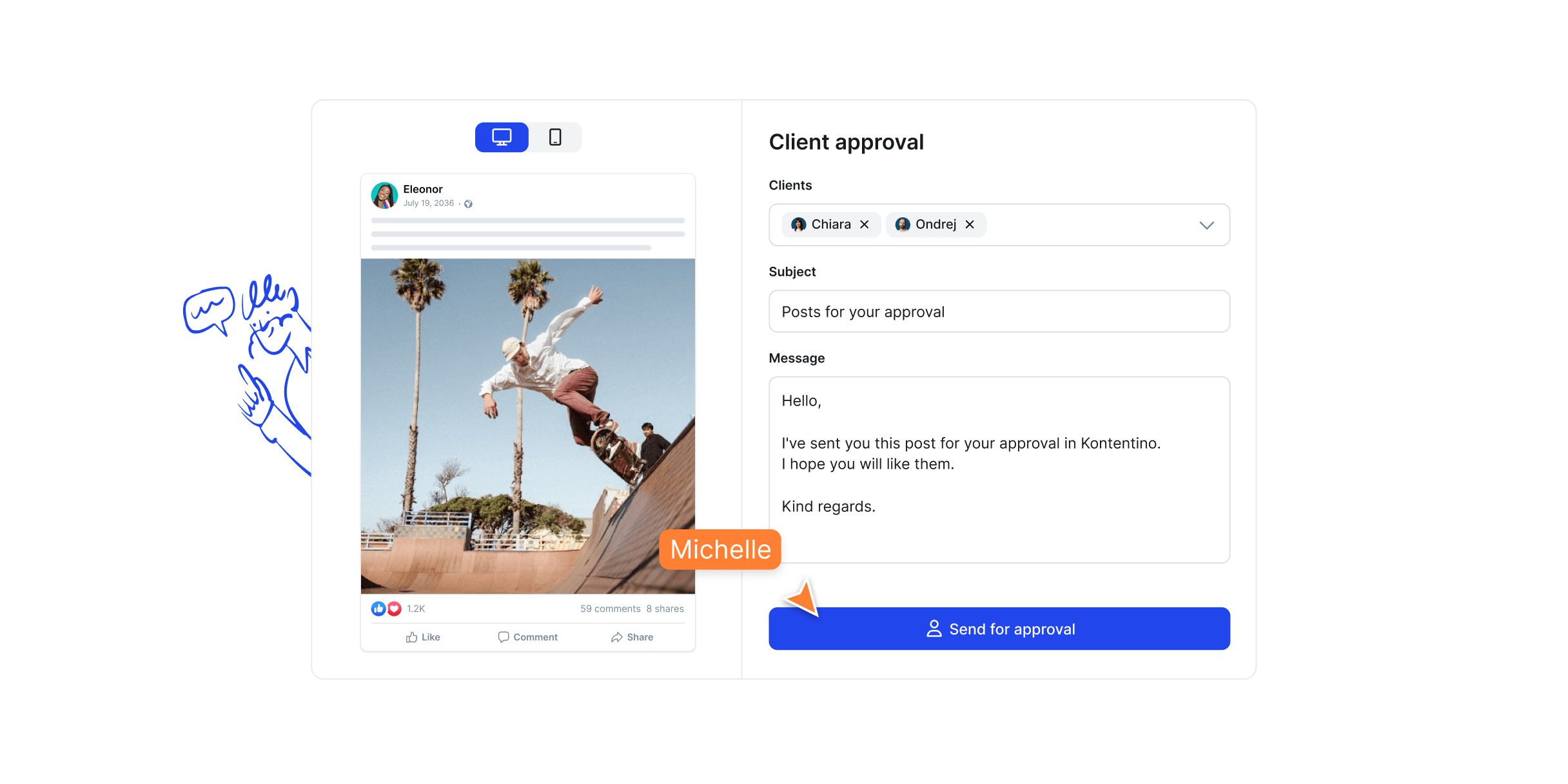
The payoff is a Monday morning where the dashboard answers “what’s mine?” for every team member, sorted by account – instead of a standup spent reconstructing it.
Step 5: Put one check between “done” and “scheduled”
The last line of defense against the wrong-logo incident is a review step that happens where the content lives, not in a screenshot thread.
A lightweight brand-team flow looks like this:
- Creator finishes the post and the status flips to done.
- The reviewer – usually the social lead – sees it in the live preview, exactly as it will look on each network: crop, caption, link, first slide.
- Approve, or send back with a comment pinned to the post.
- Approved posts get scheduled – and only approved posts get scheduled.
In Kontentino, internal approvals are built in from the Starter plan, and the live post preview shows desktop and mobile rendering per platform while you review. A pre-publish checklist can hold your standard checks (alt text, link tested, hashtags) and shows who completed each item. If someone outside the workspace needs to see a post before it goes out – a product manager, a legal reviewer – a preview link shows them the post exactly as it will look live, with no account needed. Approving and commenting happen from an invited account with the right role.

When Telekom HU moved this flow out of Excel and into one place, the team went on to schedule more than 5,000 posts through it – the Telekom HU story is a good picture of what the before and after looks like for a brand team. For a multi-market version, Kikkoman grew from 1 to 16 profiles in two years, running approvals for 14 of 16 EMEA markets in one workspace.
One calendar, owned accounts, one check before scheduling. Try the whole flow free for 14 days, no credit card required, or book a demo and we’ll map your accounts onto it live.
How to choose a tool for managing multiple accounts
The old version of this guide listed tools. A list goes stale – criteria don’t. If you’re evaluating tools for multi-account brand work, test these five things on a trial, with your real accounts:
- One calendar, all networks. Every account visible in one view, filterable by profile, status, and campaign. If the tool makes you switch workspaces to see your own brand, it’s built for agencies, not you.
- Create once, adapt per network. Duplicating a post across networks with per-network tweaks should take seconds. Watch for tools where “cross-posting” means identical content everywhere.
- Ownership and roles. Tasks on posts, named assignees, and roles that limit who can edit what and who can schedule. A tool where everyone can do everything scales exactly as well as a shared password.
- Review before scheduling. An internal approval step with a true-to-platform preview, on the plan you can actually afford – check which tier includes it, because many tools gate approvals to upper plans.
- Pricing that fits one brand. Watch the pricing basis: per-seat pricing taxes team growth, per-brand-workspace pricing is built for agencies. For one brand with several accounts, flat plans with bundled users and profiles are usually the honest fit.
Run the evaluation on two weeks of real content, not a demo dataset. The friction you feel in week one is the friction you’ll feel every week.
FAQ: managing multiple social media accounts
How do I manage multiple social media accounts in one place?
Use one planning calendar for all accounts, group profiles so one post can publish to several networks, adapt each post’s variant per network instead of rewriting it, assign a named owner to every account and a task to every post, and add one internal review step with a live preview before anything gets scheduled.
How many social media accounts can one person manage?
It depends on posting cadence and engagement load more than on the account count. One person with a single calendar, per-network duplication, and scheduled publishing can realistically run 5 to 10 accounts for one brand. Without those, even three accounts generate constant context-switching.
Should I post the same content to all my social media accounts?
Post the same message, not the same post. Keep the campaign and core content consistent, then adapt format, length, links, and crops per network. Identical cross-posting reads as automated and performs worse on networks whose formats it ignores.
What’s the best way to keep multiple accounts consistent with our brand?
Centralize planning so every post is visible before it publishes, use roles so only the right people edit and schedule, and run every post through a preview-based review step. For multi-market brands, a global-to-local content flow keeps central control while local teams adapt.
Do I need a social media management tool to run multiple accounts?
Below two or three accounts, native schedulers and a shared spreadsheet can limp along. Beyond that, the coordination cost – re-entering content, chasing status, checking four tools – exceeds the price of a management tool. Evaluate tools on calendar visibility, per-network adaptation, ownership, review steps, and a pricing basis that fits a single brand.
What’s different about managing accounts for clients instead of one brand?
Client work adds separated workspaces, client-facing approvals, and pricing math across a roster. That’s a different workflow with different tool requirements – covered in our guide to managing multiple social media clients.
Run all your accounts from one calendar
Pick your two busiest weeks of content, load them into Kontentino, and run them across every account from one view. More than 4,000 brands rate the experience 4.7 stars on both G2 and Capterra. The 14-day trial needs no credit card, and if you’d rather see your own accounts mapped first, book a demo and we’ll do it together.